PFT labeled by the MESR since 2008
CIR & CICo approved priv. center 2022-23-24-25-26

BilBot

BilBot logo

BilBot

Building Innovation & Learning with roBOT
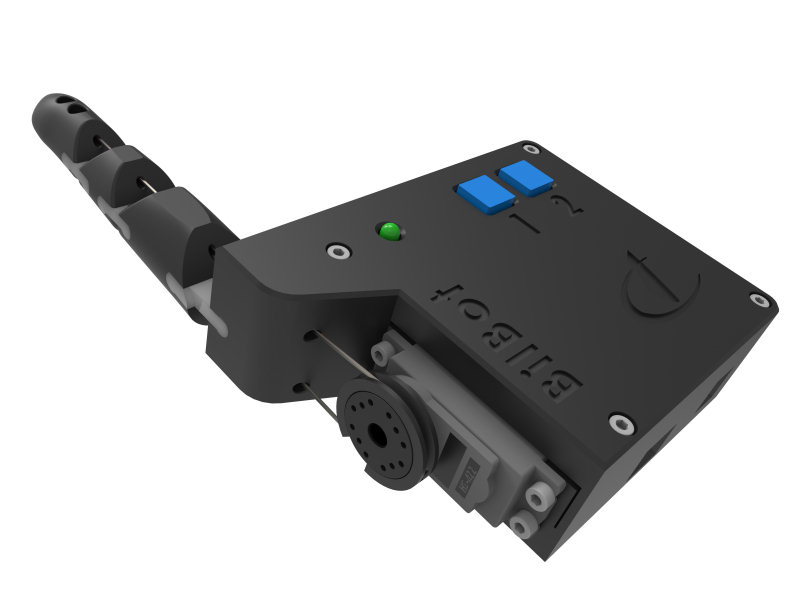

BilBot Discovery


  • Introduction to basic programming (Mblock, Arduino, BlueTooth)
  • Designed and manufactured at PFT Innovaltech (3D Printing)
  • Open source and scalable (access to 3D files to add new features)
  • 1 version available:
    • Pre-assembled (ready-to-use kit + technical support)

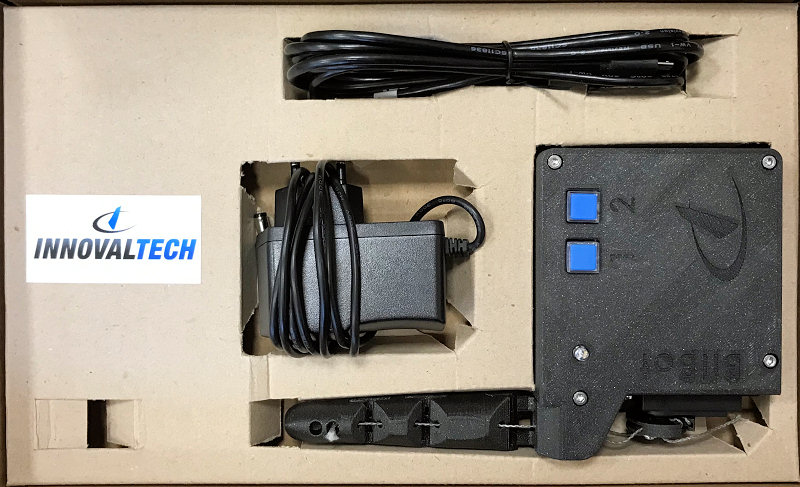
BilBot Discovery with effort sensor


  • Arduino Nano: Programmed with Mblock or Arduino IDE. Easy connection of components with the Shield.
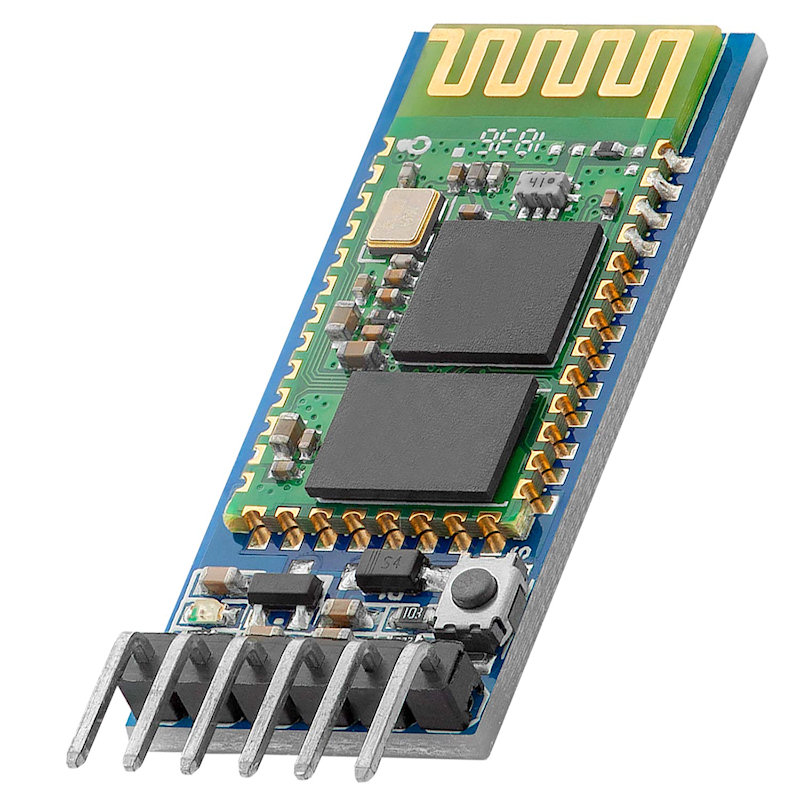
  • HC-05 Bluetooth module: Connected to the Arduino Nano board, allows the finger to be controlled with a dedicated Android application: BlueFinger
  • Thumb with force sensor and display:
    • Detects the effort exerted on the thumb
    • Allows you to pinch objects between finger and thumb
    • Display of effort on the screen

Features

  • Control a servo motor to close and open the finger
  • Convert the analog information from the effort sensor into mass in order to be able to process it
  • Pinch objects using the force sensor
  • Display the effort measured by the force sensor on the screen
  • Control the kit via Bluetooth with your phone using the BlueFinger application or other applications from the store
  • Use the buttons to control the finger and the LED
  • All CAD files, technical user and programming documents are open source for teachers

BilBot Advanced


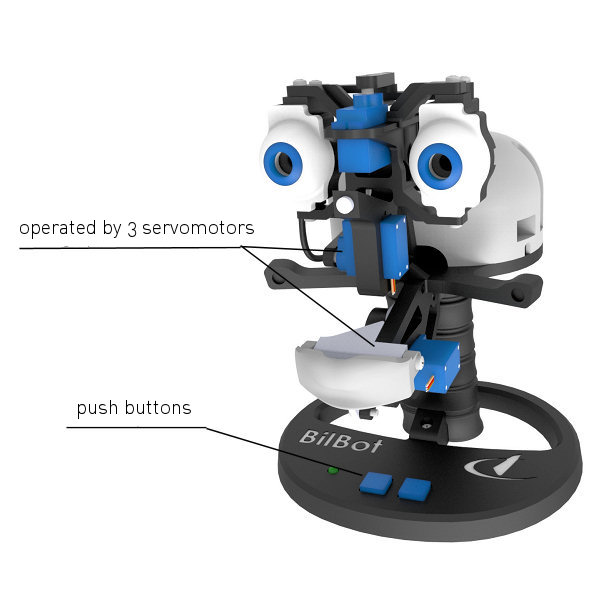
The kit is equipped with 3 servomotors, one to control the movement of the mouth and 2 others to control the movements of the eyes.
To control the servomotors, you can either:

  • Use the buttons (having previously programmed the card)
  • Use Bluetooth to remotely manage motion
  • Program the cards to automate motion
  • For Arduino version, use Scratch to manage motion with your computer keyboard or other.

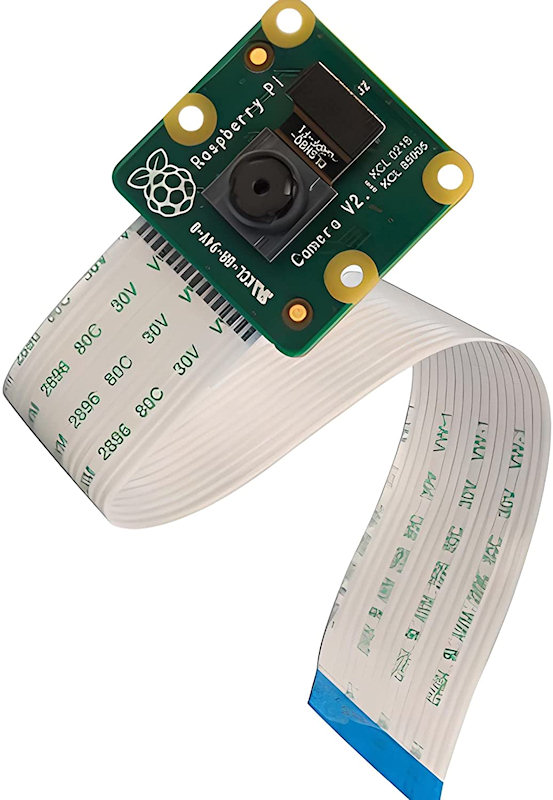
The kit also includes a camera housed in the right eye of the robot. This allows facial recognition for example.

A loudspeaker is also integrated so that speech can be simulated.

For Raspberry version, the card can be connected to the internet. Then, BilBot can become a voice assistant with which you can interact (live translation, etc.).

Features

  • Control eye and mouth servo motors with Arduino IDE or Mblock
  • Connect the Raspberry PI 3B+ card and the Arduino Nano card of the kit with serial link (UART protocol)
  • Control BilBot via Bluetooth with your phone using the BlueBot app or other apps from the store
  • Make BilBot hear , speak and see with Raspberry PI 3B+
  • Go further by making speaking translator or image processing applications (face detection for example) with BilBot
  • This kit is not open source

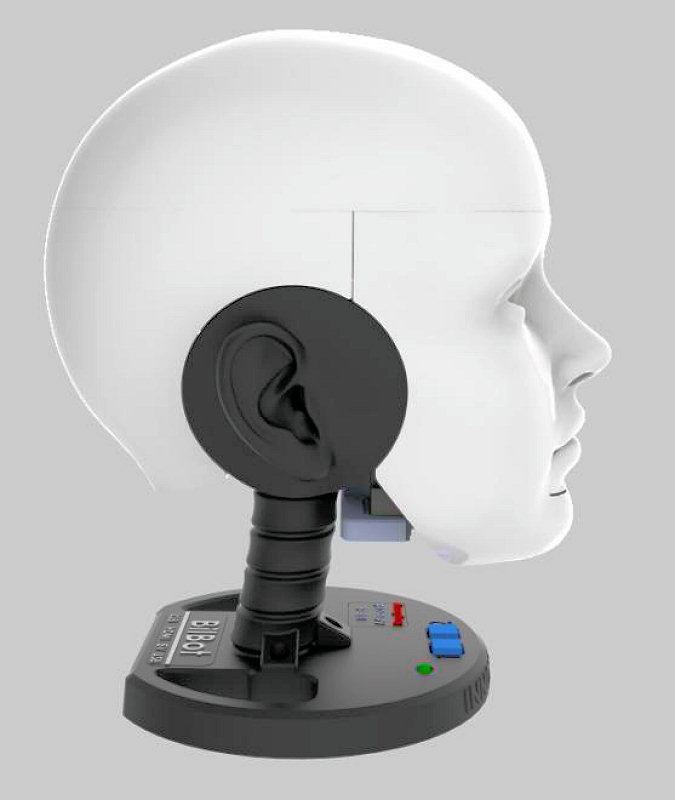
BilBot Advanced with bust and neck


  • Realistic movements: Head flexion forwards and to the sides, 120° head rotation. With the mechanism of cables stretched by servomotors, BilBot can tilt his head to look down and up
  • Advanced design and realization: Designed and optimized for 3D printing. Articulation printed in flexible TPU to follow the flexions and rotations of the neck. Entirely made in 3D printing, the panels of the bust are magnetized to the structure, allowing easy access to the inside (thermoformed version to come)
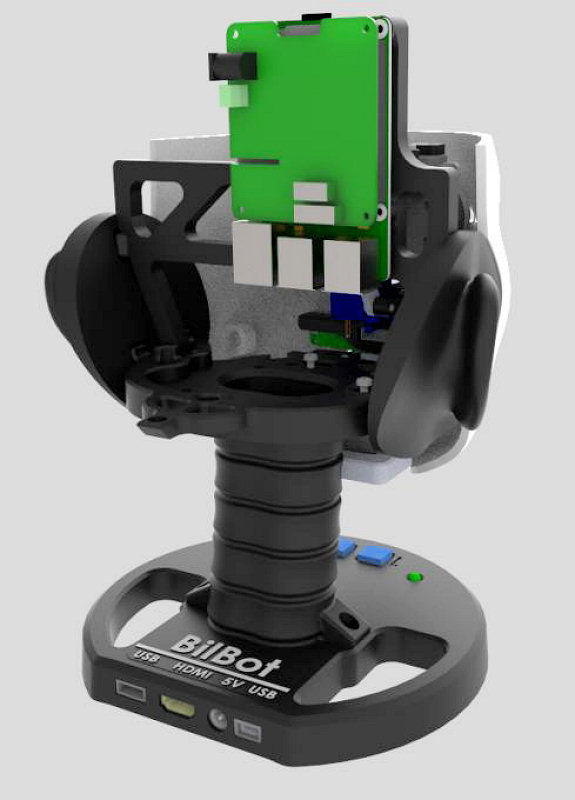
  • Electronics similar to classic BilBot Advanced: BilBot Advanced with bust and neck is equipped with an Arduino card (controlling the servomotors), a Raspberry card (voice synthesis, image processing, etc.), a Bluetooth module, a PI cam, etc.

Features

  • Control eye, mouth and neck servo motors with Arduino IDE or Mblock
  • Connecting the Raspberry PI 3B+ card and the Arduino Nano card of the kit with serial link (UART protocol)
  • Control BilBot and the bust via Bluetooth with your phone using the BlueBot app or other apps from the store
  • Make BilBot hear , speak and see with Raspberry PI 3B+
  • Go further by combining the image processing possible with the Raspberry PI and the controlling of servomotors by following an object or a face with your gaze and head
  • This kit is not open source