Crimping is an assembly between two or more materials that are bonded in compression or expansion. It is a common method used to to achieve sealing between two elements or example, or mechanical bonding stressed in tension / compression / torsion, or to create a very intimate electrical connection.
Effective and esay to use, Magnetic Pulse Crimping (MPC) can adapt to a very wide range of materials, such as high strength steels, or already heat-treated aerospace aluminum. In a word, there are not any limits: it is even possible to crimp metals on plastics, composites, or even fragile materials like ceramic or glass!
Crimping parts do not require any special pre-treatment, and the process is extremely stable.
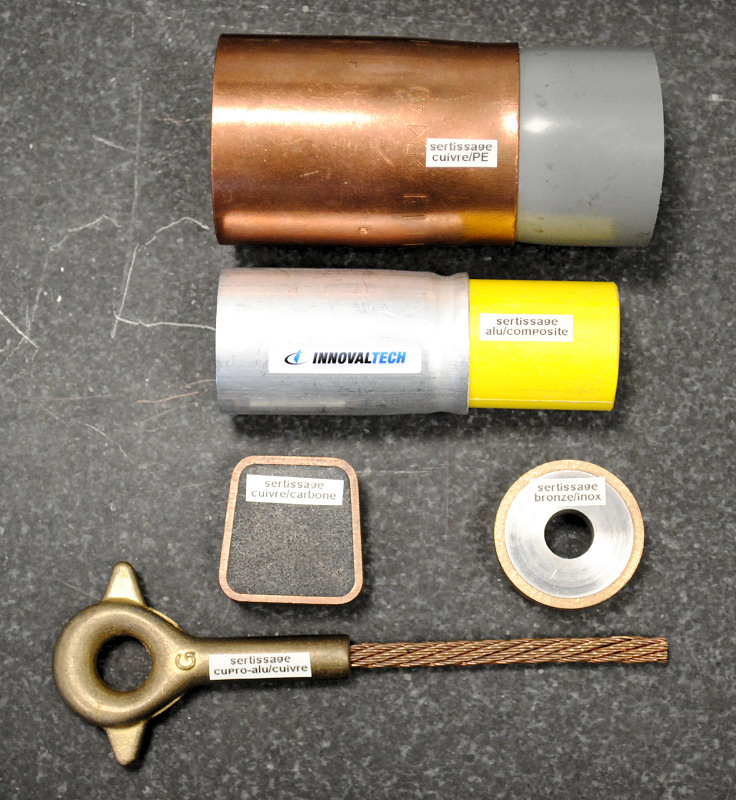

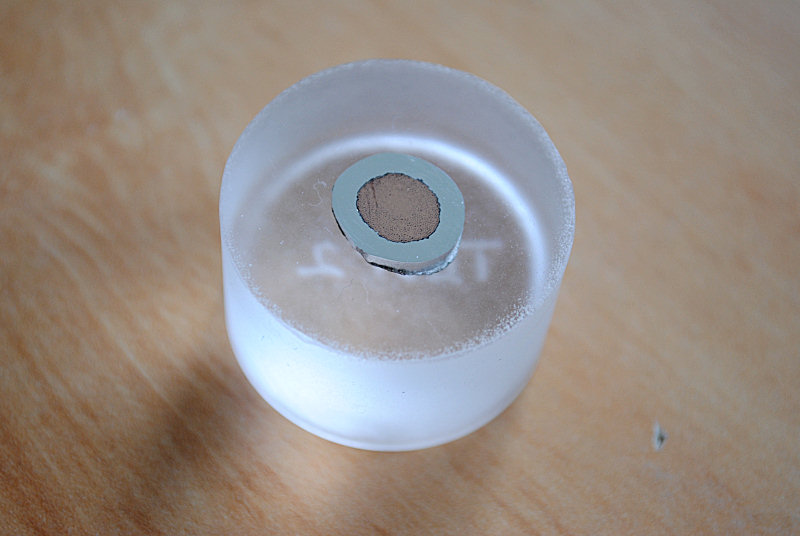
Some pairs of materials have the reputation of not being able to be welded together. Magnetic Pulse Welding (MPW) can do it!
In the tooling, a large amount of energy is released in a very short pulse. This can range up to 110 kJ in 10 μs. At the moment of the impact, a fusion on a few microns occurs at the interface. This weld is almost cold so the workpiece can be manipulated with bare hands just after the process.
During welding, the impact speed can reach 1000 km/h. To obtain a weld, a distance of about 1 or 2 millimeters is required between the parts to allow the moving part to accelerate before colliding.
MPS welding can be applied to tubular, square, rectangular shapes, etc. But also on sheets.


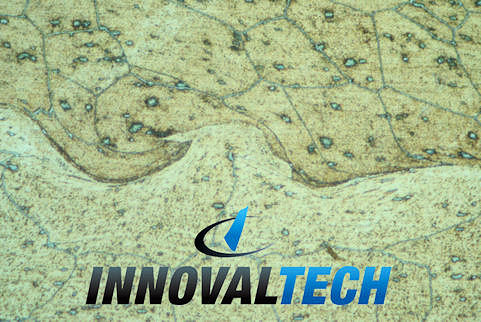
At the impact, a "jet" phenomenon occurs. This jet blows a tiny fraction of the metals, which strips them, and, under the effect of the very high pressure involved, combines the ideal conditions for the creation of a solid-state weld. This type of weld does not alter the crystalline structure of the metals (non-thermally affected zone).


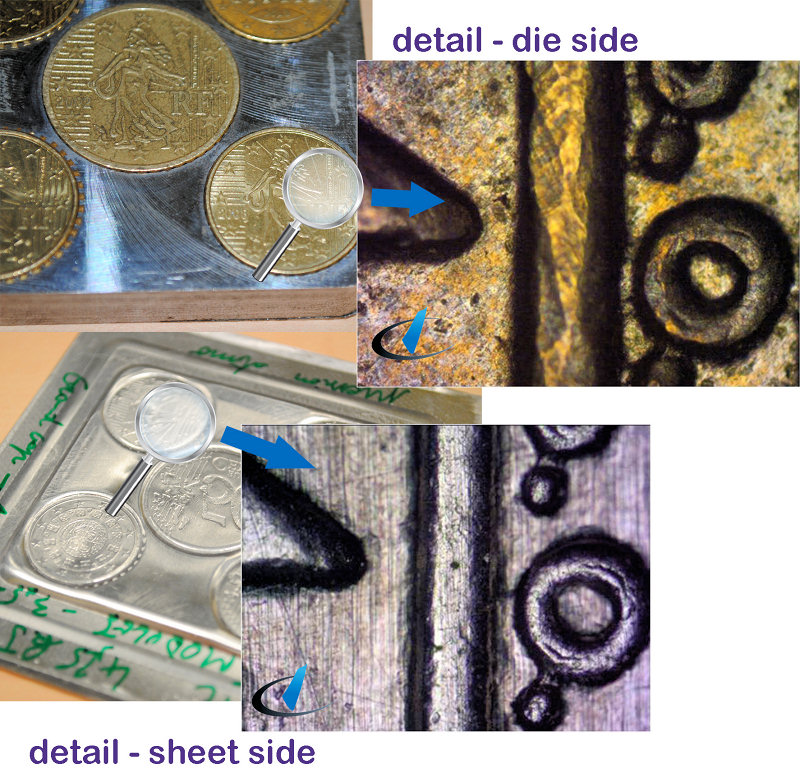
Magnetic Pulse System makes it possible to deform tubes or sheets without any contact. Since the workpiece is moved by a pulsed magnetic field, the shaping tool (the die) is the only required part (no punch). The impact on this tool can be used to cut (Magnetic Pulse Cutting - MPC) with minimal burrs, but also to shape (Magnetic Pulse Forming - MPF), to calibrate the geometry of a complex boss or a sharp angle for example.
This process without springback, due to the high speed of the moving materials, allows greater deformations compared to conventional means, but also the forming of tiny details such as engravings.
Finally, it is possible to work on coated parts since the deformation is done without contact with a punch.


Espace Scolaire Condorcet - 17 rue Henri Hertz
02100 SAINT-QUENTIN - FRANCE
+33 (0)3 23 08 44 89 - pft.innovaltech@u-picardie.fr
PFT Innovaltech is supported by the Hauts-de-France Region


conception & design: Eric Grenot - Copyright © 2026 PFT Innovaltech